


Image
Légende
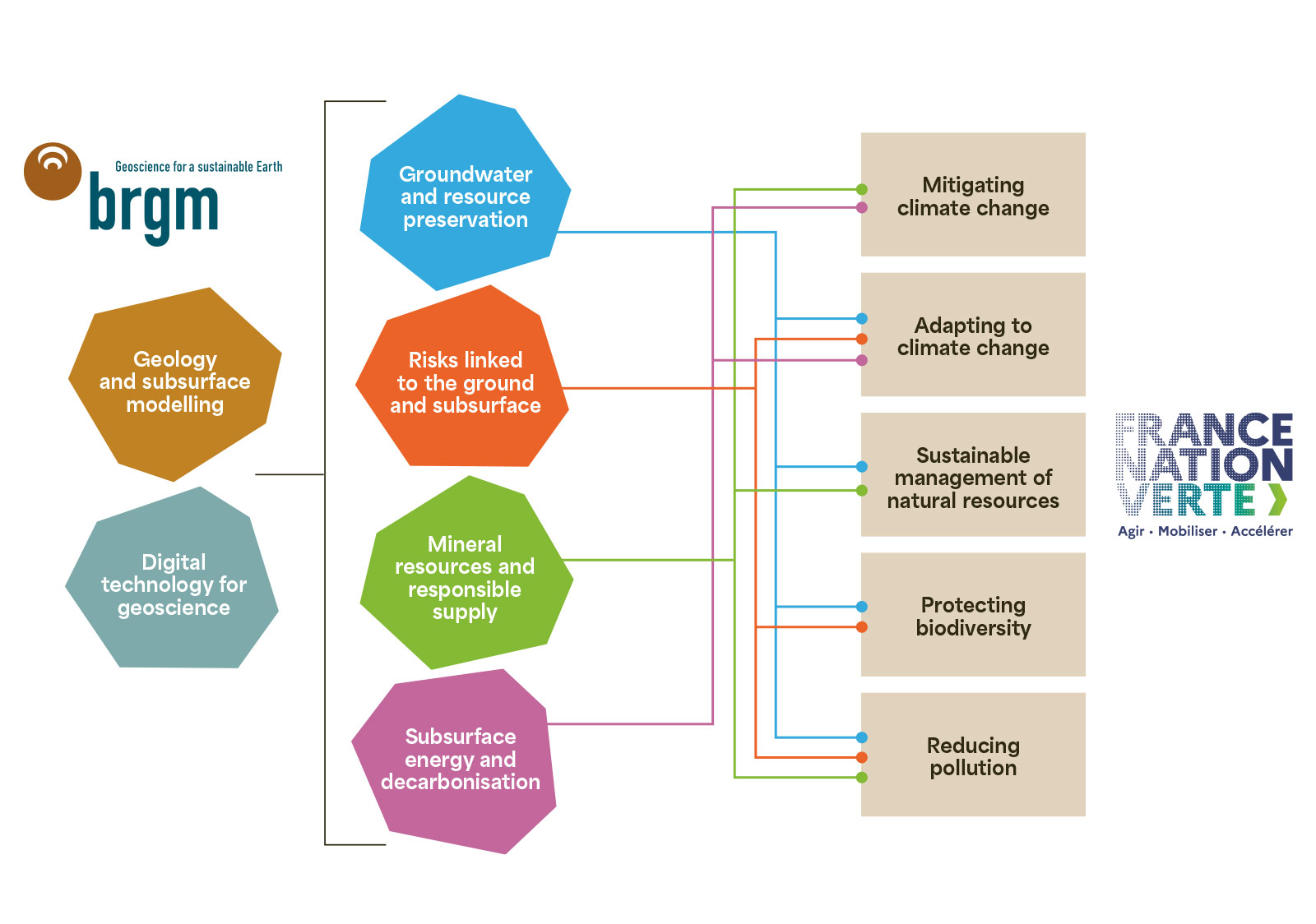
The six scientific and societal issues underpinning the work of BRGM allow it to act on all aspects of the ecological transition. © BRGM
 French geological survey
Climate ambitions
The six scientific and societal issues underpinning the work of BRGM allow it to act on all aspects of the ecological transition. © BRGM
In response to climate change and the current upheavals in the Earth system, BRGM is fully committed to answering scientific questions, raising awareness of issues and opening up new possibilities, in order to provide society with the understanding and resources necessary to address current and future challenges. To this end, it is carrying out ambitious research projects, providing independent expertise to public authorities, and deploying training and scientific outreach initiatives aimed at civil society.
“Our work is guided by a scientific strategy revised in 2024, in line with the national reference pathway for climate change, based on a 4°C rise in temperature in France by 2100,” says Frédéric Glanois. “We are committed to doing more, whether in supporting efforts to adapt to climate change and reduce net greenhouse gas emissions, or in addressing the other major issues raised by the ecological transition, all of which are intrinsically linked.” At the same time, and in line with its scientific output, BRGM has initiated a wide-ranging plan to maximise its impact on society and, more particularly, to reduce its environmental footprint: the master plan for Sustainable Development & Social and Environmental Responsibility, a transformation project for the period 2025–2030 involving all activities and all staff (see pages 68–69).
BRGM is calling for the subsurface to be recognised as a lever for the energy transition and decarbonisation, with its energy resources and storage capacities. Through its work, BRGM is seeking to contribute to the emergence and consolidation of solutions that could be implemented on specific sites or at the regional level.
> Supporting the development of geothermal energy in all its forms / Enabling secure underground storage of energy, carbon and radioactive waste / Exploring natural hydrogen resources / Securing the supply of the mineral resources required for the transition.
BRGM's work on water and natural hazards provides fundamental input for policies on adaptation, as well as contributing to research efforts to overcome scientific barriers. These initiatives cover the entire cycle: preparing for adaptation, assessing risk, identifying options, implementing actions, monitoring and assessing measures, and are supported by BRGM’s digital infrastructure, enabling the development of climate-related services.
> Planning and acting for better water management/ Improving knowledge of the subsurface / Modelling risks / Preparing for extreme events / Developing nature-based solutions.
Water resources
As co-pilot of the national research programme "OneWater - Water as a common good”, and the government’s delegated project coordinator for the management of the national piezometric network, BRGM is the leading player in the field of groundwater management. Committed to scientific research and support for public policy, as well as to international cooperation, it is seeking to develop our understanding of the hydrogeological and biogeochemical behaviour of aquifers, with a view to implementing better quantitative and qualitative management of groundwater and the associated environments.
> Understanding and managing groundwater resources / Taking action at local level through research and data analysis.
Mineral resources
By monitoring the entire life cycle of mineral raw materials – particularly in its capacity as coordinator of Ofremi (French Observatory of Mineral Resources for Industrial Sectors), BRGM is involved at key stages: identifying ore deposits; promoting responsible mining; developing innovative and cost-effective resource extraction processes; and recovering waste, including mining waste, through recycling. In this way, it is seeking to promote responsible sourcing in economic activities.
> Managing the life cycle of mineral resources / Ensuring transparency and traceability in the supply chain / Promoting the development of a responsible European mining sector.
BRGM is committed to promoting more responsible use of land and groundwater, in order to minimise the impact of future activities on human health and ecosystems. It is also studying current and “legacy” pollution, with the aim of developing remediation techniques to conserve or rehabilitate urban soil and restore the ecosystem services they provide.
> Preserving groundwater quality / Remediating degraded soil and decontaminating polluted environments.
Learn more about BRGM's efforts to support the ecological transition

