Image
Légende
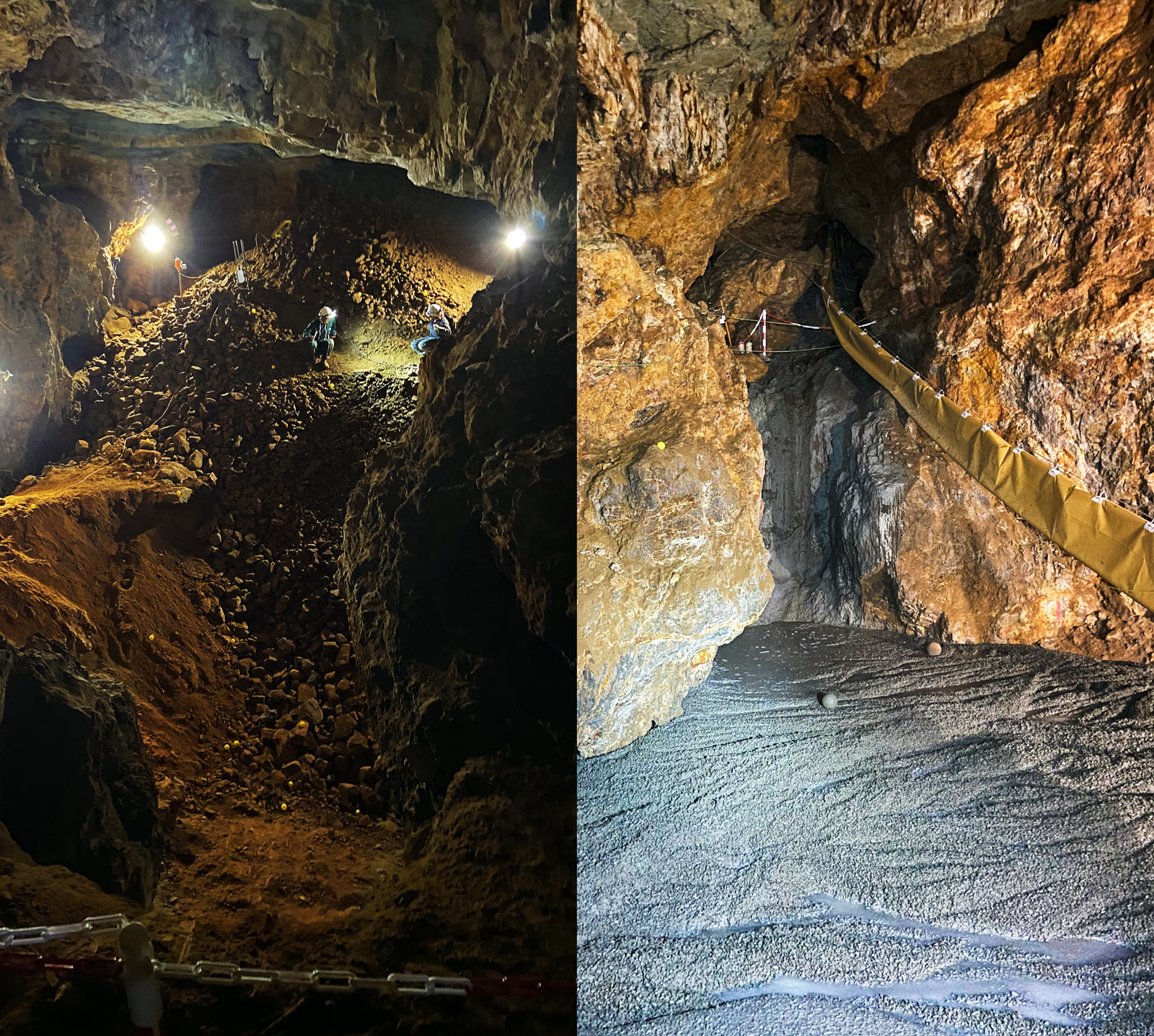
A view of the interior of the main chamber of the mine in Le Pradal, before (left) and during (right) its infilling with concrete. © IGECAV
 French geological survey
Risks linked to the ground and subsurface
A view of the interior of the main chamber of the mine in Le Pradal, before (left) and during (right) its infilling with concrete. © IGECAV
For more than ten years, the mine in Le Pradal had been closely monitored in order to assess the risks and protect the 325 inhabitants of this village, whose centre is situated above the site of this former silver-lead mine. In 2018, a high risk of collapse was identified around the main chamber (10 metres below ground), which resulted in the narrow tunnels in the upper part of the mine being filled in.
But then, “the roof of the main hall was in danger of collapsing due to shearing, a movement that could not be detected by the monitoring system we had put in place and which, therefore, could not have been foreseen,” explains Florence Rivet. Consequently, the decision was taken to conduct further infilling, following the completion of the archaeological excavations.
“Since we were unable to continue monitoring the mine whilst the archaeologists were carrying out their work, we rehoused the seven families living directly above the area to be filled in, as soon as the excavations began. In consultation with the families, of course, and with the support of the sub-prefecture, the DREAL and the town hall,” says Florence Rivet. A temporary car park was also set up on a sports ground; the latter was restored to its original state at the end of the works and even features a new pump track!
The work started in March 2025. High-density fibre-reinforced concrete was first injected into the main chamber via the entrance, in order to stabilise the base of the pillar that risked collapsing. Watertight barriers were then installed at the entrances to the tunnels leading off from this area. They were closed in order to prevent any loss of material, but also to regulate the ventilation system in place in order to limit operators’ exposure to radon, which is naturally present in the mine.
The operation to fill in the 16-metre-high cavity then continued with a lighter foam concrete, to reduce the load on the deeper, unfilled tunnels. By May 2025, the work had been completed. A few weeks later, after a surveyor had checked that no damage had been caused to the houses, the families were able to return to their homes.
Find out more about this project