Image
Légende
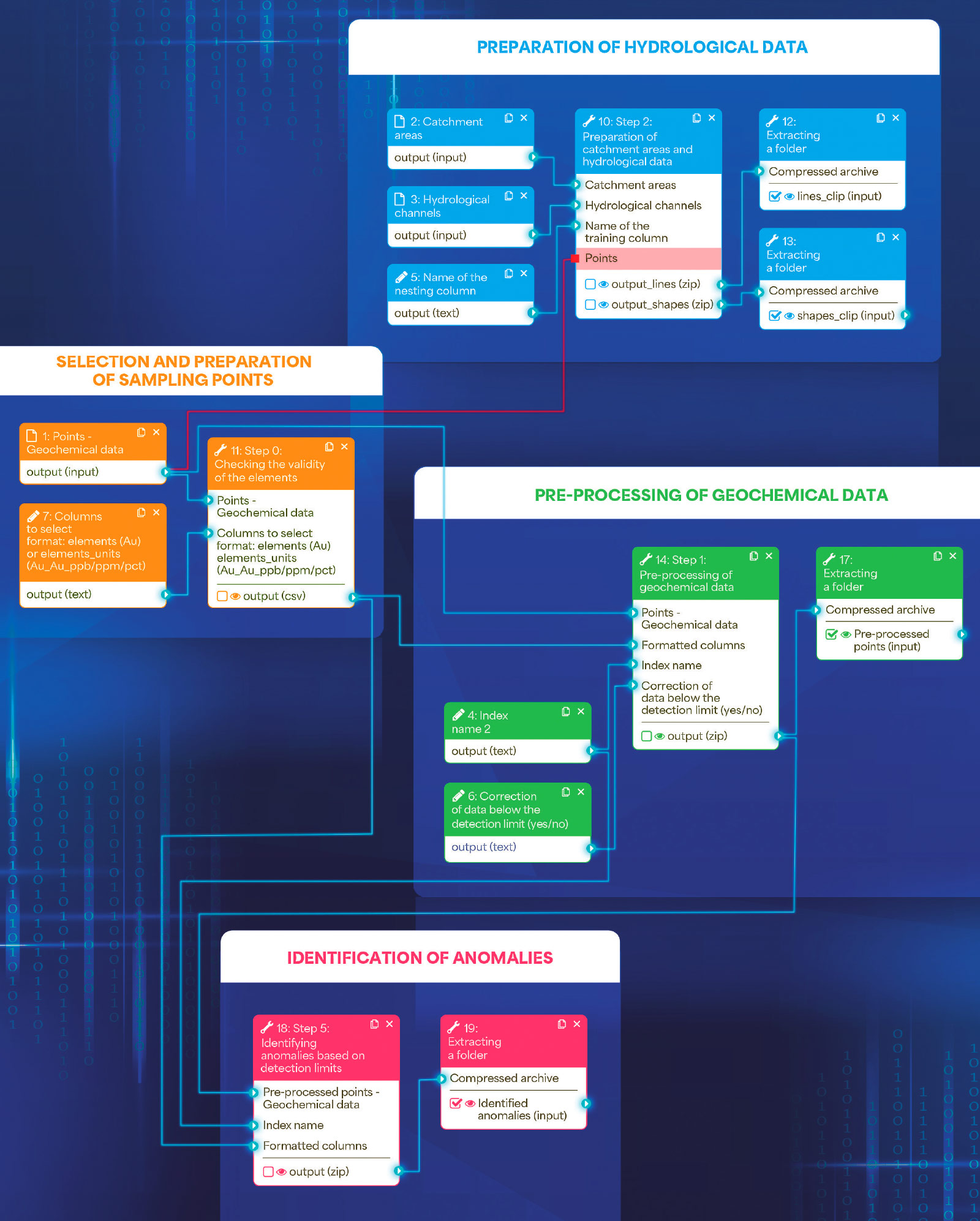
Sequencing data processing steps in BRGM’s integrative digital platform (PNI) as part of its remit to update the national inventory of mineral resources. © brgm
 French geological survey
Digital technology for geoscience
Sequencing data processing steps in BRGM’s integrative digital platform (PNI) as part of its remit to update the national inventory of mineral resources. © brgm
The integrative digital platform (PNI) is the cornerstone of a major transition for BRGM. Its aim is to centralise, secure and simplify access to the scientific data, tools and workflows (processing) used by the organisation and its partners, while promoting the sharing and publication of results in the scientific community. With the growing importance of digital projects, it addresses a strategic challenge: avoiding data silos and ensuring long-term interoperability between the various initiatives. “Rather than coming up with a series of piecemeal solutions,” Pascal Delaporte points out, “BRGM has opted for a common platform, capable of developing in line with scientific and technological needs.”
One of the key components of this architecture is the data access module (MAD). By “linking” to catalogues structured around a wealth of standardised metadata such as BRGM’s Cupidon and other external catalogues, it helps in finding resources and speeds up the provision of the requested data in analysis environments (Galaxy, Saphir, etc.). “The revolution brought about by the data access module is data virtualisation: this module retrieves data from where they are stored without moving them elsewhere,” explains Pascal Delaporte, who is encouraging all BRGM scientists to enter all their data, including work data, into the Cupidon catalogue so that it can be made available.
Another advantage of the PNI is the seamless management of workflows, with the “containerisation” of processing codes to enable their interoperability and sequencing. “The PNI,” says Pascal Delaporte, “is intended for two types of users: developers who upload their processing code onto it, and scientists who select and combine these different building blocks to create complete workflows.” A module called GHOST also uses the existing processing chains in the PNI at remote sites or platforms.
“The ongoing introduction of the Orison project into the integrative digital platform will provide access to the technologies and building blocks needed to create digital twins, regardless of the subject area: hydrogeology, geochemistry, mineral resources, geothermal energy, risk management, etc.,” says Romain Chassagne. The purpose of this BRGM-led research project is to develop and provide a predictive digital environment dedicated to data assimilation. In particular, it is based on the integration and merging of multi-source, multi-scale data and on the (semi-)automatic updating and calibration of multi-physical models, using hybrid approaches that incorporate artificial intelligence.
The aim is to improve prediction for systems and for systems of systems (such as coupling the surface with the subsurface) and to simulate future scenarios while quantifying uncertainties as accurately as possible. More broadly, this tool is intended to promote the development of digital twins. As Romain Chassagne explains, “it is a virtual representation of a physical system such as a city, a natural environment or even a machine, which is dynamically linked to its real-world counterpart.”
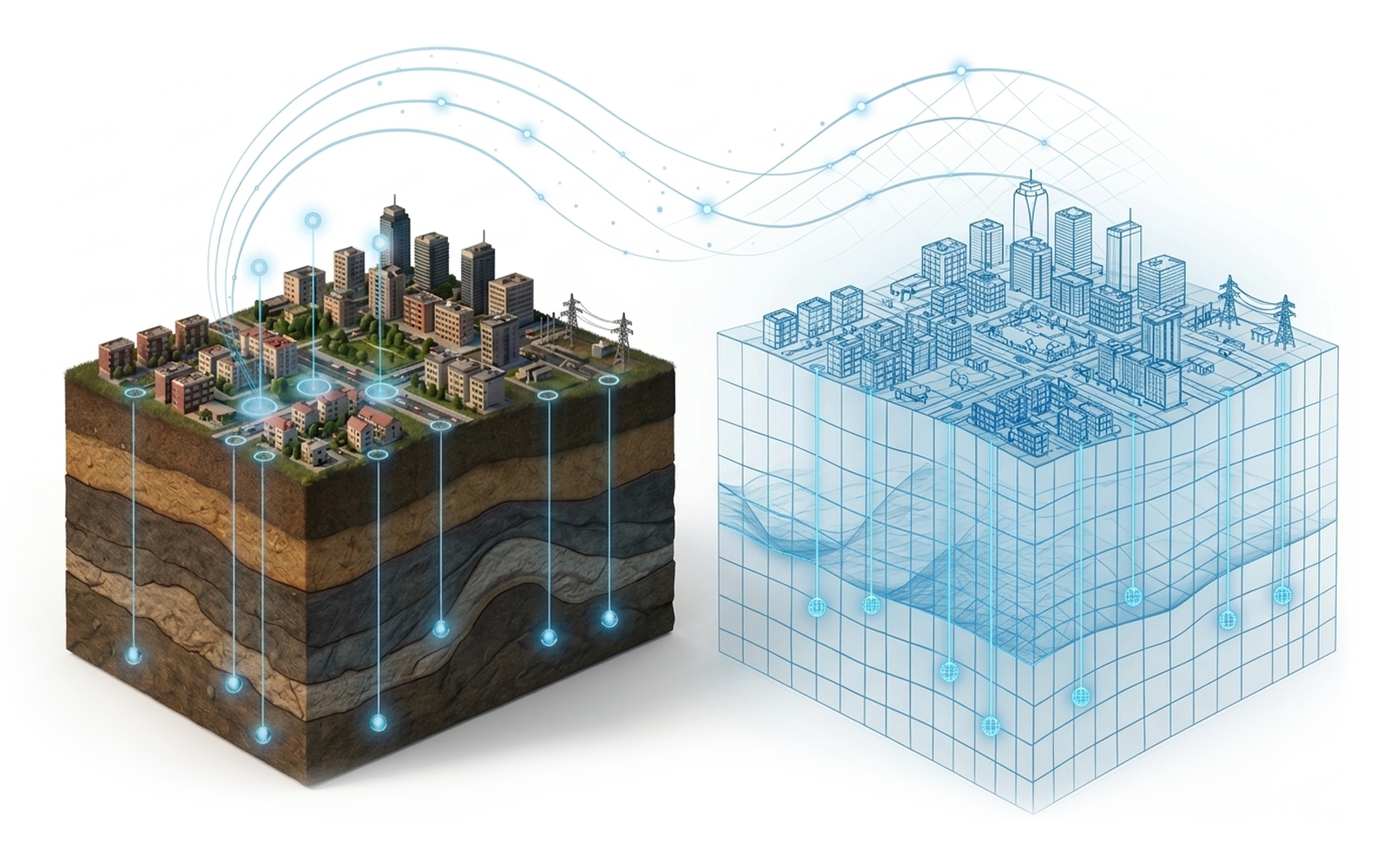
Graphic representation of a digital twin of an area, combining both surface and subsurface information. On the left, the real world; on the right, its digital twin. © BRGM
The PNI is in line with the national data sharing strategy for sharing geological, hydrogeological and environmental data in accordance with the FAIR (Findable, Accessible, Interoperable, Reusable) principles. It is closely linked to Data Terra, a national research infrastructure that pools Earth system observation data. The PNI is also linked to national research programmes (PEPR) and their data platforms, with a view to ensuring their long-term sustainability and optimum use beyond 2030. Finally, it forms part of a European framework, notably by aligning with the requirements of the EOSC (European Open Science Cloud) and by collaborating with initiatives such as EuroGeoSurveys. This positioning strengthens BRGM’s role as a key player in ground and subsurface data infrastructure both in France and across Europe.
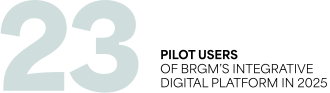
With the online launch in 2025 of an alpha version of the integrative digital platform, “pioneer” users could test its technical aspects, but could also start contributing content. It is currently being rolled out across the whole of BRGM. “Far more than just a technical solution, the PNI is a driver of cultural transformation,” emphasises Pascal Delaporte. “It encourages teams to carefully consider their data and data processing right from the outset and to document and share them. It is backed up by a comprehensive change management programme involving PNI ambassadors, training sessions, tutorials and feedback.”