Image
Légende
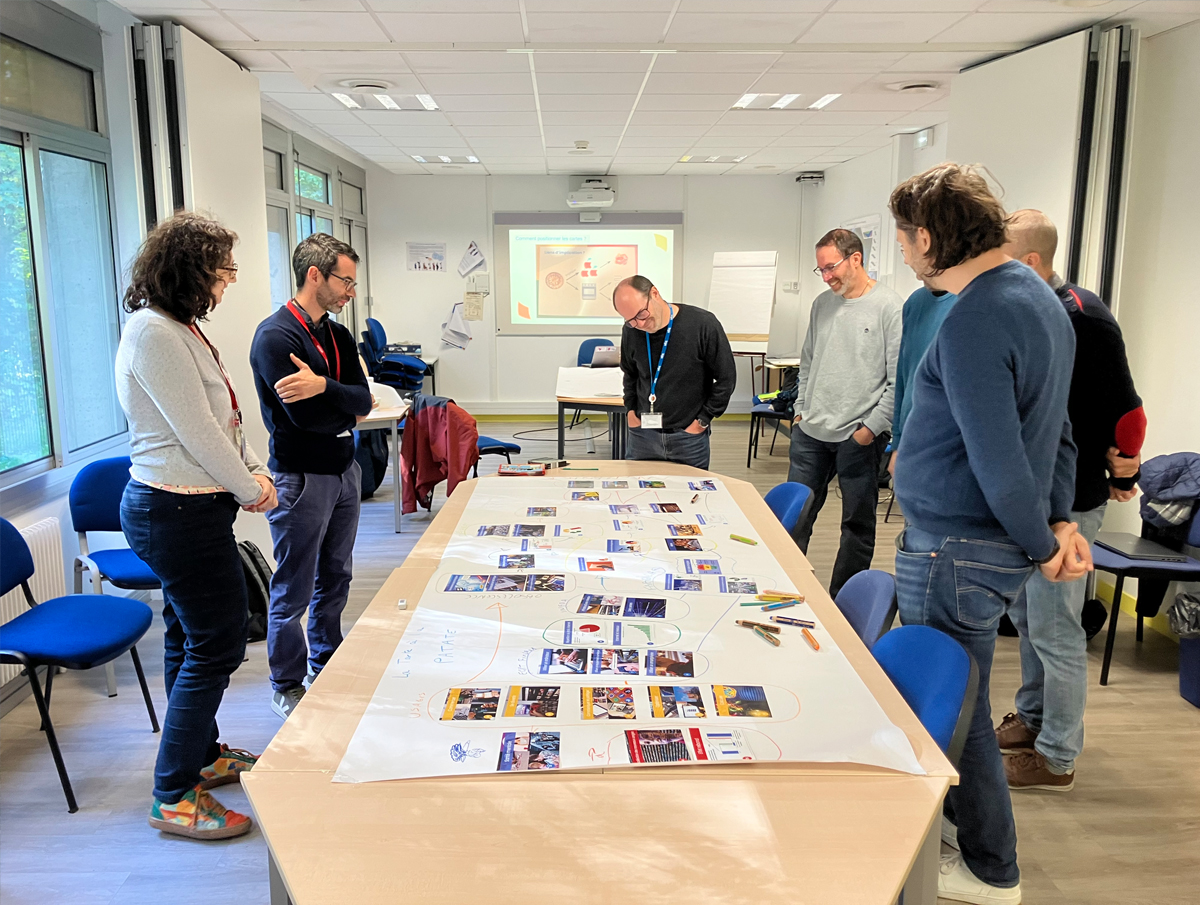
In October 2025, employees were invited to consider how to adapt their practices towards more responsible digital behaviour – in particular through the “Digital Collage” initiative. © BRGM
 French geological survey
Sustainable development
In October 2025, employees were invited to consider how to adapt their practices towards more responsible digital behaviour – in particular through the “Digital Collage” initiative. © BRGM
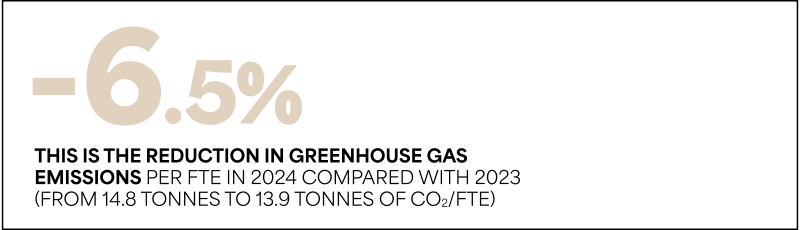
Implementation of our 2025–2030 SD&SER master plan is off to a good start: BRGM’s 2024 greenhouse gas emissions assessment for Scopes 1 to 3* showed a reduction of 5.9% compared with 2023 or, relative to the organisation’s workforce, a reduction of 6.5% per FTE. This improvement can mainly be explained by the combined reduction in diesel consumption by the BRGM fleet (-11%), volume of goods transported by air (-29%), number of visitors to the Orléans site (-19%), emissions due to accommodation (-22%) and the number of capital assets, as well as the extension of the useful life of computers (from 5 to 7 years) and the reduction in purchases made (-9% overall), the latter of which accounts for the organisation’s main carbon footprint.
As a framework document, the 2025–2030 SD&SER master plan sets out BRGM’s commitments to contributing to the ecological transition and an equitable society, and is based on two key pillars: climate, biodiversity and resources on the one hand, and social progress on the other. “It encompasses all our activities – research, support for public policy development, post-mining management and support activities – and involves all staff,” emphasises Philippe Sabourault.
This comprehensive, unifying project gives rise to specific initiatives every year, beginning with those that staff consider a priority. In 2025, BRGM signed an agreement with Emmaüs Connect to donate all or part of its unneeded IT equipment. The laptops, computer monitors, smartphones and tablets collected will be refurbished for the benefit of people affected by social and digital exclusion. Monitors that were no longer in use were also offered to any staff who wanted them, in particular to improve their remote-working conditions.
To encourage cycling, new covered bike parking spaces have been created. A partnership has also been signed with BlaBlaCar Daily to promote and encourage car-sharing for employee commutes, using a mobile app designed specifically for this type of short-distance travel.
With regard to buildings, a study was carried out to assess the feasibility of installing a renewable energy production system on the roofs – following the example of the solar panels on the building housing the regional post-mining unit for Eastern France – or covering them with vegetation. The results will be taken into account in the building renovation programme currently being implemented. Rainwater collection tanks have also been installed at the Orléans site with a view to reusing the water for irrigating green spaces or in the bicycle repair workshop.
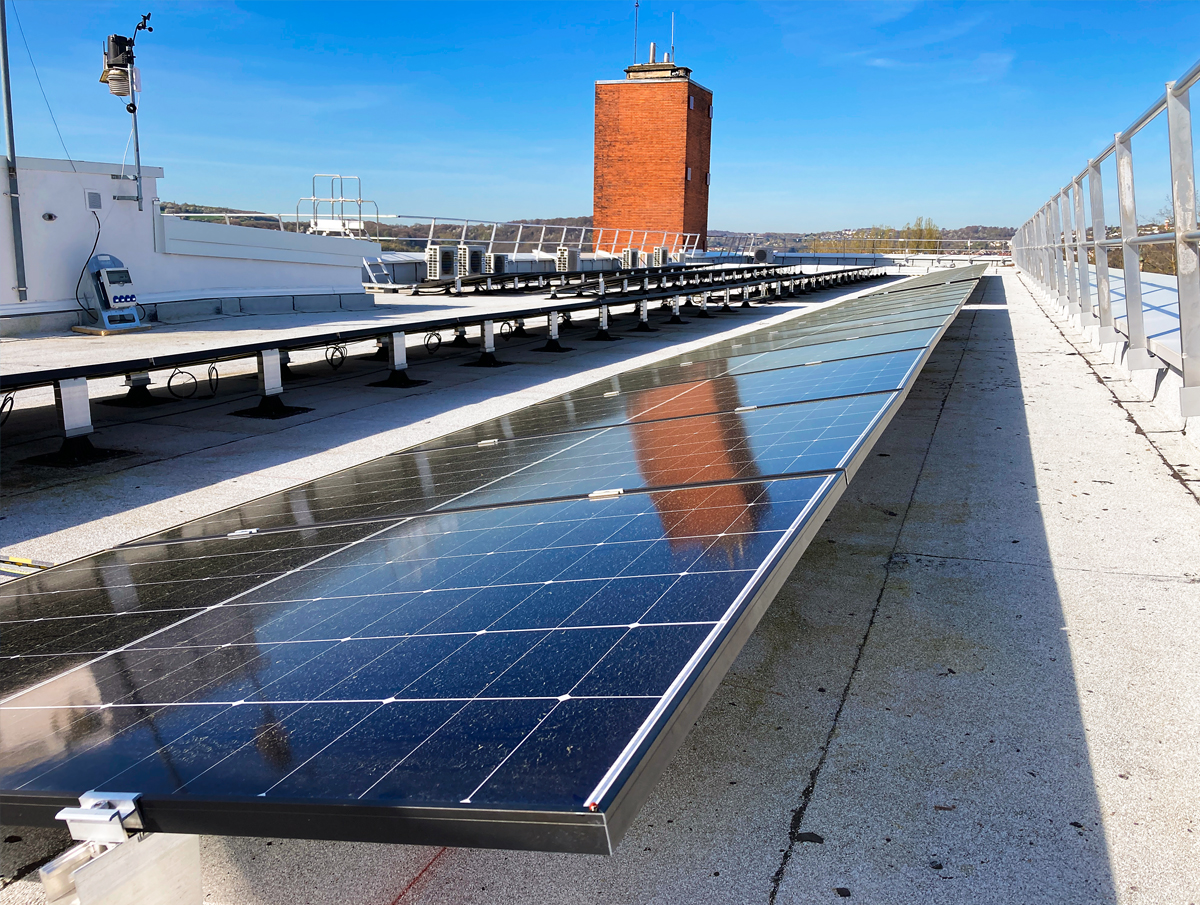
The building housing the regional post‑mining unit for Eastern France, located in Freyming-Merlebach, has been fitted with solar panels with the aim of reducing its carbon footprint and optimising its insulation. © BRGM
In the staff canteen, plastic water bottles have been replaced by water in cartons, and more organic produce has been added to the menus. And to raise awareness and increase employee involvement, a CSR training course has been added to the in-house training catalogue, and further information on this topic has been added to the intranet. A workshop on responsible use of digital technology was also organised, during which participants learned about the environmental impacts of digital technology and devised practical solutions to limit them.
Efforts will continue in 2026, with no fewer than 14 priority actions, such as the development of a strategy to promote socially and environmentally responsible procurement. “The path has been mapped out: to reduce BRGM’s carbon footprint by 5% each year in order to achieve net zero by 2050,” reiterates Philippe Sabourault.
* Scope 1: direct greenhouse gas (GHG) emissions – Scope 2: indirect emissions associated with energy consumption, resulting from imported electricity – Scope 3: other indirect GHG emissions, namely goods transport, employee commutes, travel by customers and visitors, business travel, product purchases, capital assets, waste disposal and the use of other services.
The Quality and Environmental Management System (QEMS) is a key tool in the running of the organisation. It helps to support BRGM's scientific and technical strategy and achieve the objectives set out in its contract with the Government. In this regard, efforts to simplify procedures continued in 2025, thanks mainly to the customer relationship management (CRM) system, which facilitates and strengthens traceability of the various decision-making steps involved in compiling bids. Feedback has also been reviewed in order to learn more lessons from the strengths and difficulties encountered in project management.
Greater efforts were directed to consideration of risks in 2025, with tailored support provided to project managers to underpin the shift towards preventive management of hazards. In addition, integrated mapping has been put in place for accounting and financial risks, as well as those relating to cross-functional processes. These risks are presented to the audit committee each year and are subject to internal monitoring.